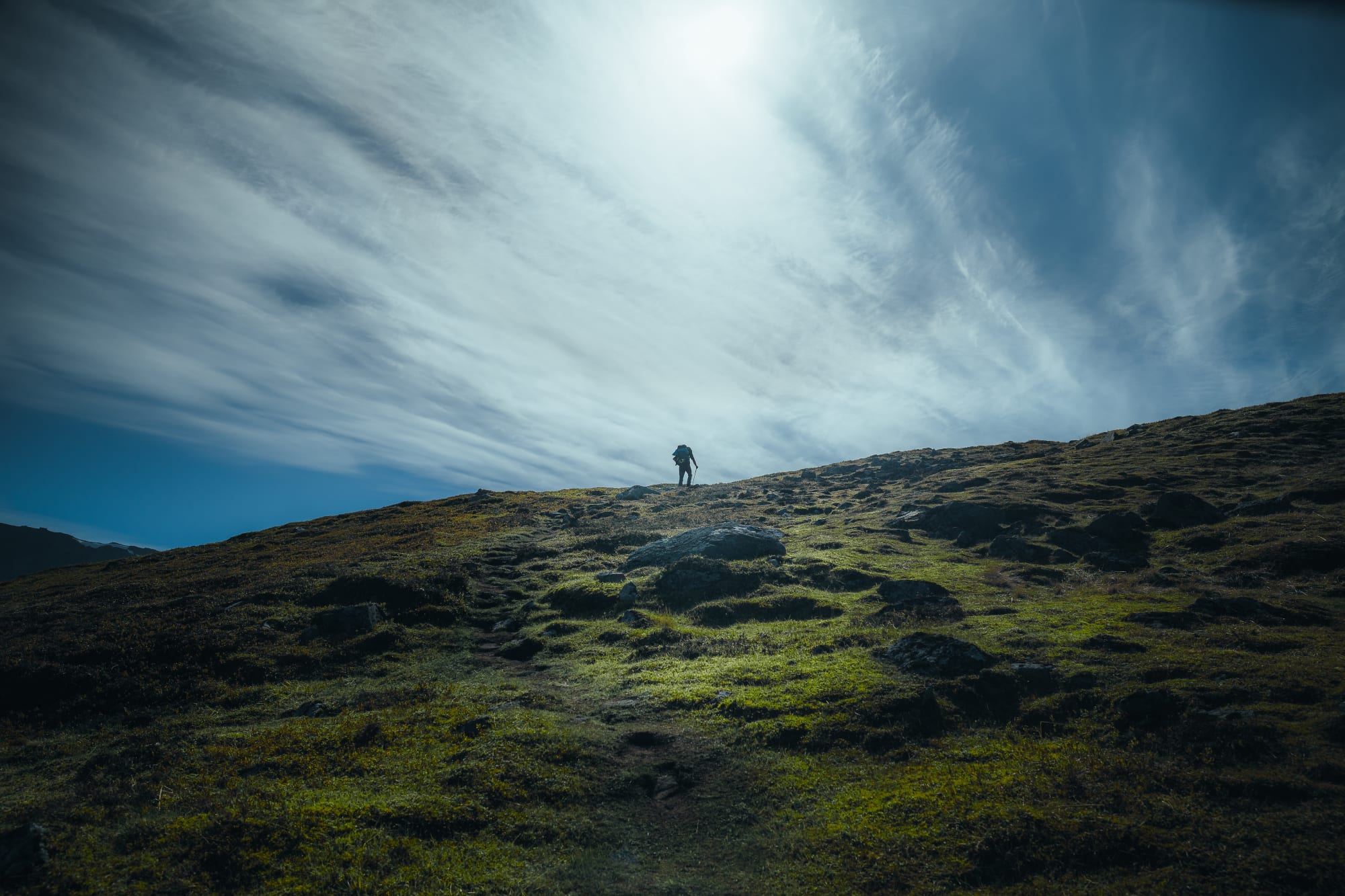
Lofoten Long Crossing
Topographic maps turn a three-dimensional landscape into something you can fold and carry in your pocket. They're elegant, information-dense, and once you learn to read them, they change how you see terrain — even when the map is still in your pack.
Contour Lines
This is the heart of it. Contour lines connect points of equal elevation. Every line represents a specific height above sea level, and the interval between lines (usually 10 or 15 metres on a 1:25,000 map) tells you how steeply the land rises or falls.
Close together: steep ground. The closer the lines, the steeper the slope. If they're almost touching, you're looking at a cliff or a very steep bank.
Far apart: gentle ground. Wide spacing means flat or gently rolling terrain — good for easy walking, but also for bogs and marshland.
Concentric circles: a summit or hilltop. The smallest circle at the centre is the highest point.
V-shapes pointing uphill: a valley or stream bed. Water flows down through these V-shapes, and the point of the V always indicates the direction of higher ground.
Contour lines are the grammar of the landscape. Once you learn to read them, the map becomes a story.
Scale and Distance
A 1:25,000 map means 1 centimetre on the map equals 250 metres on the ground. That's four centimetres to a kilometre. This is the standard walking scale — detailed enough to show field boundaries, individual buildings, and small streams.
For planning, remember that distance on a map is flat distance. The actual walking distance on steep ground will be longer, and the time considerably more. A good rule of thumb: add one minute for every 10 metres of ascent.
Grid References
Grid references let you pinpoint any location on the map to within 100 metres. The system uses a six-figure number: three figures for the easting (left to right) and three for the northing (bottom to top).
Read right, then up. Always. The easting comes first, the northing second. This is worth memorising because it could genuinely save you one day — when you're calling for help, a grid reference is the fastest way to communicate your position.
Putting It Into Practice
The best way to learn map reading is to use a map while walking. Start with a familiar route. Hold the map, orient it to north (using your compass or landmarks), and follow your progress along the path. Notice how the contour lines match what you see: the steepness of slopes, the shape of ridges, the way valleys curve.
Trail Takeaways
- •Contour lines close together mean steep ground — plan your effort accordingly
- •Always read grid references right then up
- •Add one minute per 10m of ascent when estimating walking time
- •Practice on familiar routes before relying on a map in new terrain
- •Carry your map in a waterproof case — a wet map is a useless map
After a few walks, something shifts. You stop seeing the map as a diagram and start seeing it as a landscape. The contour lines become hills. The blue threads become streams. The dotted lines become paths you can feel underfoot. That's when map reading becomes map feeling — and that's when it becomes genuinely useful.